Why Do Some Divers Seem to Stay Underwater Forever?
Have you ever surfaced from a dive and discovered your buddy still has significantly more air remaining than you?
If so, you’re not alone.
One of the most common questions divers ask is:
“How can I improve my air consumption?”
The good news is that air consumption is a skill that improves with experience. Most divers become more efficient underwater as they gain confidence, refine their techniques, and develop better diving habits.
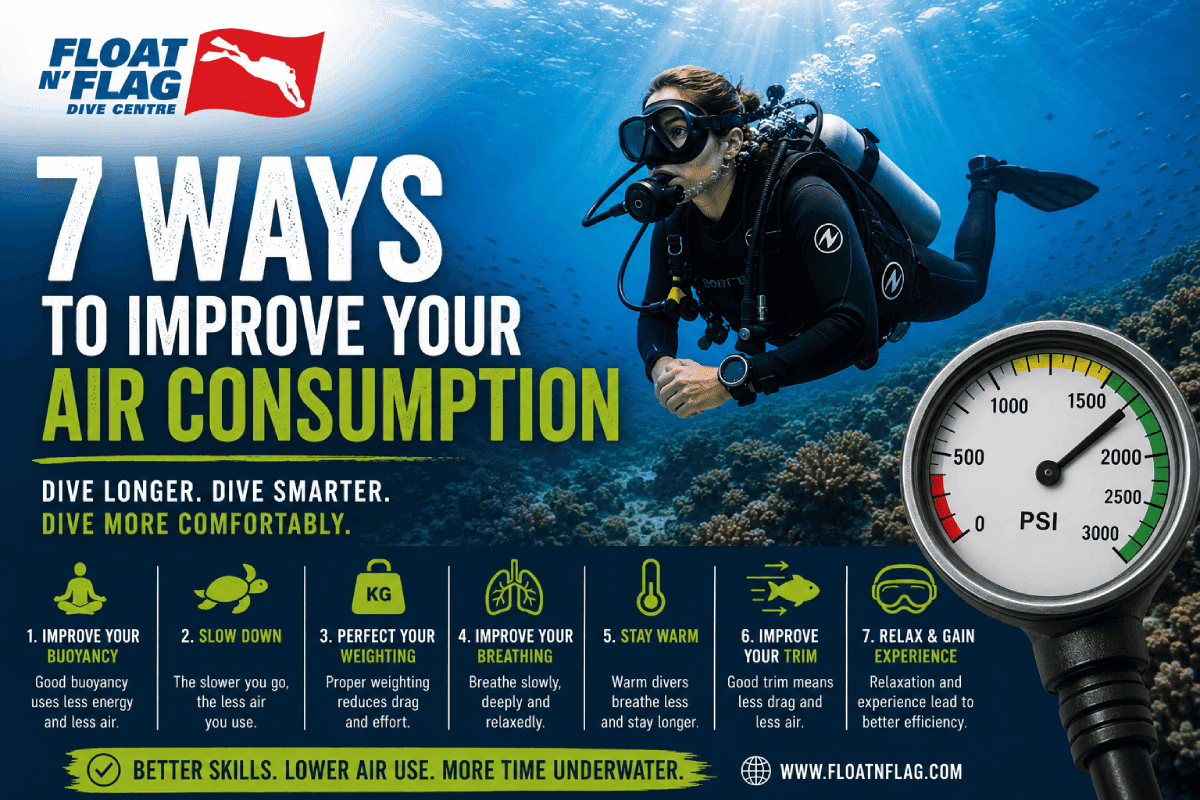
Let’s look at seven proven ways to improve your air consumption and enjoy longer, more comfortable dives.
1. Improve Your Buoyancy
If there is one factor that impacts air consumption more than any other, it’s buoyancy.
Divers who are constantly inflating, deflating, kicking, and correcting their position underwater use significantly more energy—and more air.
Good buoyancy allows you to:
- Hover effortlessly
- Reduce unnecessary movement
- Improve trim and positioning
- Relax underwater
This is one reason why Peak Performance Buoyancy is one of the most valuable specialty courses available.
The less energy you use maintaining your position, the less air you’ll consume.
2. Slow Down
Many new divers move through the water much faster than necessary.
The faster you swim:
- The harder your muscles work
- The more oxygen your body requires
- The more air you consume
Try slowing down and enjoying the dive.
Many experienced divers discover more marine life because they move slowly and take time to observe their surroundings.
Remember:
Scuba diving is not a race.
3. Perfect Your Weighting
Many divers carry more weight than they actually need.
Excess weight creates a chain reaction:
- More lead
- More air in your BCD
- More drag
- More effort
- Higher air consumption
Proper weighting helps you maintain better buoyancy and reduces the amount of energy required throughout the dive.
If you’re unsure whether you’re properly weighted, speak with an instructor during your next dive.
4. Improve Your Breathing
One of the biggest myths in diving is that you can hold your breath or skip breaths to conserve air.
Never do this.
Instead, focus on:
- Slow breathing
- Deep breathing
- Relaxed breathing
- Consistent breathing
The goal is not to breathe less.
The goal is to breathe efficiently.
A calm, relaxed breathing pattern naturally reduces air consumption while improving comfort underwater.
5. Stay Warm
Cold divers use more air.
When your body becomes cold, it works harder to maintain its core temperature.
This increased effort results in:
- Faster breathing
- Increased air consumption
- Reduced comfort
Whether you’re diving in Ontario or travelling abroad, appropriate exposure protection is essential.
A comfortable diver is usually a more efficient diver.
6. Improve Your Trim
Trim refers to your body position in the water.
Divers with poor trim often:
- Swim at awkward angles
- Create additional drag
- Work harder than necessary
A streamlined, horizontal position allows you to move through the water more efficiently.
Less drag means less effort.
Less effort means less air consumption.
7. Relax and Gain Experience
This may be the most important tip of all.
New divers are often excited, focused, and occasionally nervous.
That’s completely normal.
As you gain experience, you’ll become more comfortable with:
- Your equipment
- Your buoyancy
- Your breathing
- Your surroundings
Confidence leads to relaxation.
Relaxation leads to lower air consumption.
Many divers discover their air consumption improves dramatically after their first 20–50 dives without making any major changes at all.
What About Fitness?
Physical fitness can certainly help improve air consumption.
Divers who maintain good cardiovascular fitness often experience:
- Improved endurance
- Reduced fatigue
- Better breathing efficiency
However, technique, buoyancy, weighting, and relaxation usually have a much greater impact than fitness alone.
The Goal Isn’t to Beat Your Buddy
It’s easy to compare air consumption with other divers.
But remember:
Every diver is different.
Factors such as:
- Body size
- Fitness level
- Experience
- Equipment configuration
- Dive conditions
all influence air consumption.
The goal isn’t to use less air than your buddy.
The goal is to become more comfortable, efficient, and confident than you were on your last dive.
Float N’ Flag Tip
If you’re serious about improving your air consumption, start by focusing on buoyancy and proper weighting.
These two skills alone often produce the biggest improvements for newer divers.
Many divers are surprised to discover that a simple buoyancy tune-up can significantly increase both comfort and bottom time.
Ready to Become a More Efficient Diver?
Whether you’re a newly certified Open Water Diver or an experienced diver looking to refine your skills, improving air consumption is one of the best investments you can make in your diving.
At Float N’ Flag Dive Centre, our instructors can help you improve your buoyancy, weighting, trim, and overall diving efficiency through continued education and local diving opportunities.
The result?
Longer dives, greater comfort, and more time enjoying the underwater world.
Want to Improve Your Buoyancy and Air Consumption?
Ask us about our Peak Performance Buoyancy course and upcoming local diving opportunities.
You’ll be amazed at the difference a few small adjustments can make.